-
Mon To Sat 10:00 am To 7:00 pm
-
Ayodhya nagar, Nagpur, Maharashtra.
×
Request Sent a Appointment
Speciality
High Tibial Osteotomy (HTO)
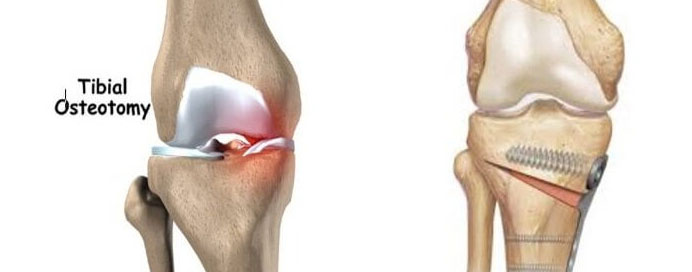
High Tibial Osteotomy (HTO) is a surgical procedure used to realign the knee joint and relieve pressure on damaged cartilage, particularly in patients with early-stage osteoarthritis or knee deformities. It is commonly performed on younger, active patients who experience medial compartment osteoarthritis (wear and tear on the inner knee) but want to delay or avoid total knee replacement. During the procedure, the surgeon cuts and repositions the upper part of the tibia (shinbone) to redistribute weight more evenly across the knee joint. This helps reduce pain, improve function, and prolong the knee's natural lifespan. HTO is often recommended for patients with knee malalignment, such as bow-legged (varus) deformity. By shifting weight away from the damaged area, the procedure promotes better knee mechanics and slows down joint degeneration.
Indications (When It’s Needed):
Medial compartment osteoarthritis (damage to the inner knee).
Varus deformity (bow-legged alignment) causing uneven joint stress.
Active patients under 60 who want to delay knee replacement.
Chronic knee pain and instability due to malalignment.
Post-traumatic knee arthritis after previous injuries.
Procedure Overview
Preoperative Planning – X-rays, CT scans, or MRIs are used to assess alignment and joint condition.
Anesthesia – The surgery is performed under general or spinal anesthesia.
Bone Cutting (Osteotomy) – A controlled cut is made in the upper tibia.
Realignment – The bone is carefully opened or closed to adjust the knee's weight distribution.
Fixation – A plate and screws or a bone wedge is used to stabilize the bone while it heals.
Closure & Recovery – The incision is closed, and rehabilitation begins.
Advantages of High Tibial Osteotomy
Delays or avoids total knee replacement.
Preserves the natural knee joint.
Reduces pain and improves mobility.
Allows continued participation in sports and physical activities.
Enhances long-term knee function.
Post-Surgical Recovery & Rehabilitation
Partial weight-bearing with crutches for 6-8 weeks.
Physical therapy to restore strength and range of motion.
Full recovery takes around 3-6 months.
Possible Risks & Complications
Bone healing issues (delayed or incomplete healing).
Infection or blood clots.
Knee stiffness or persistent pain.
Overcorrection or undercorrection of alignment.
